Préfecture de Police · Service de la Sûreté · 36, Quai des Orfèvres
The Baker Street Affair
Holmes contre Lupin, an intercepted case file, summer 1908.
Two documents reached the Bureau de Lecture on the same morning, routed through the Hôtel des Postes at place de la bourse. One bore a London frank and was addressed in a careful, undecorative hand to a Dr. J. H. W., at an address in Marylebone. The other had no postage at all, was sealed in red wax, and was left on a bench at the Gare du Nord beside an opened copy of L'Illustration.
Brief
On the night of the 17th of July, 1908, the diadem of the Empress Eugénie, mounted by Bapst & Frères, set with thirty-eight brilliants and a single rose-cut stone formerly belonging to Mazarin, was lifted from the apartments of the Duchesse de Crozon at the Hôtel Britannique, rue de la Paix. The diamonds were not the issue. The issue was that the rose-cut stone, the only piece of the parure that could not be insured, had been replaced, weeks earlier, with a paste copy of remarkable workmanship.
The British detective Mr. Sherlock Holmes was retained by the Préfecture in the morning, on the recommendation of his brother Mycroft, to whom the British Embassy had referred the matter. By the time Mr. Holmes had finished his coffee at the Hôtel, an open letter signed Arsène Lupin had been folded on the dressing-table, weighted by a single playing card, the eight of hearts, scratched through diagonally.
Both men have since written about the affair. Their accounts disagree; and the Bureau de Lecture, whose business it is to read other people's mail before they do, has now acquired both documents. Your task is the Bureau's: read both, reconcile them, and, if you can, determine what the censors at Quai des Orfèvres preferred not to put on record.
Notes for the reader
- Each document carries something the other cannot finish without. The shape of one is the key to the other; the shape of the other, when read in the writer's manner, is what the key opens.
- Mr. Lupin has standing conventions all his own. The courtesy of his correspondents has always been to recognise them, without being told.
- What the affair returns will not be a thief's name nor a jewel's. It will be a place, ordinary enough that the Préfecture filed it under a registry index and forgot it; ordinary enough that the young man in Lupin's hand, the one he does not name, walked into it every morning for six years.
- The wax seal at the foot of this file is, as M. Ganimard noted in the margin, not for ornament. The Cabinet Noir clerks slipped a transcription précis behind the wax of dossiers they considered politically inconvenient.
The documents
London · West-Central · 18 Jul 1908
Holmes: Case Note
A telegram-style note from the British detective, written in the stick-figure cipher he is known to use only with Dr. Watson and the Cubitt household at Riding Thorpe.
Open document
Paris, no postage · 18 Jul 1908
Lupin: Lettre
A letter on house paper from the Hôtel Britannique, addressed to "Mon cher rival". The hand is steady; the typesetting is not. Posted by way of a bench, the Gare du Nord, and an open newspaper.
Open document
File seal
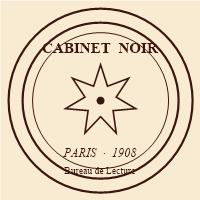
Affixed by the Bureau de Lecture, Hôtel des Postes. The wax is the deep crimson the Bureau uses for political correspondence; the impression is the seven-pointed star adopted by the Service de Lecture in 1871 and used continuously since.
Cabinet Noir clerks routinely slipped a transcription précis behind the wax of dossiers they considered politically inconvenient. A clerk's marginal note on the cover of this file reads, in pencil: « pas de copie au registre », no entry in the official ledger.