Educational tribute

Royal Observer Corps Network

An interactive tribute showing how the ROC nuclear monitoring network would have worked. Browse by Sector, zoom into a Group, and see the cluster of posts that reported up to each Group Control. Group 20 (York) is modelled in full from the March 1989 ringbell.co.uk map, including every cluster and its master post.

1,563 underground monitoring posts
5 UKWMO Sectors plus Northern Ireland
~40 posts in Group 20 (York) at peak

Interactive map

Browse by Sector, Group, and cluster

Pick a UKWMO Sector, then a Group within it. The default view focuses on Group 20 (York), the worked example for this page. Cluster master posts (red) are the radio-equipped posts that reported up to the Group Control (green). Satellite posts (blue) reported in to their cluster master.

UK map with ROC network points, clusters and Group Controls

Network primer

How the ROC turned sightings into warnings

The Corps began with aircraft reporting and later took on nuclear burst and fallout monitoring. The public story is less about bunkers alone and more about disciplined volunteers, fixed instruments, and a national reporting chain built for speed under pressure.

Compressed history

  1. Observer Corps formed for visual aircraft detection, recognition, tracking, and reporting.
  2. The Corps received the Royal title after its Battle of Britain service.
  3. Cold War duties expanded to warning and measuring radioactivity after nuclear attack.
  4. 1,563 underground monitoring posts were built across Great Britain and Northern Ireland.
  5. A major reorganisation reduced the number of operational posts.
  6. Active training ceased and the remaining underground posts closed.

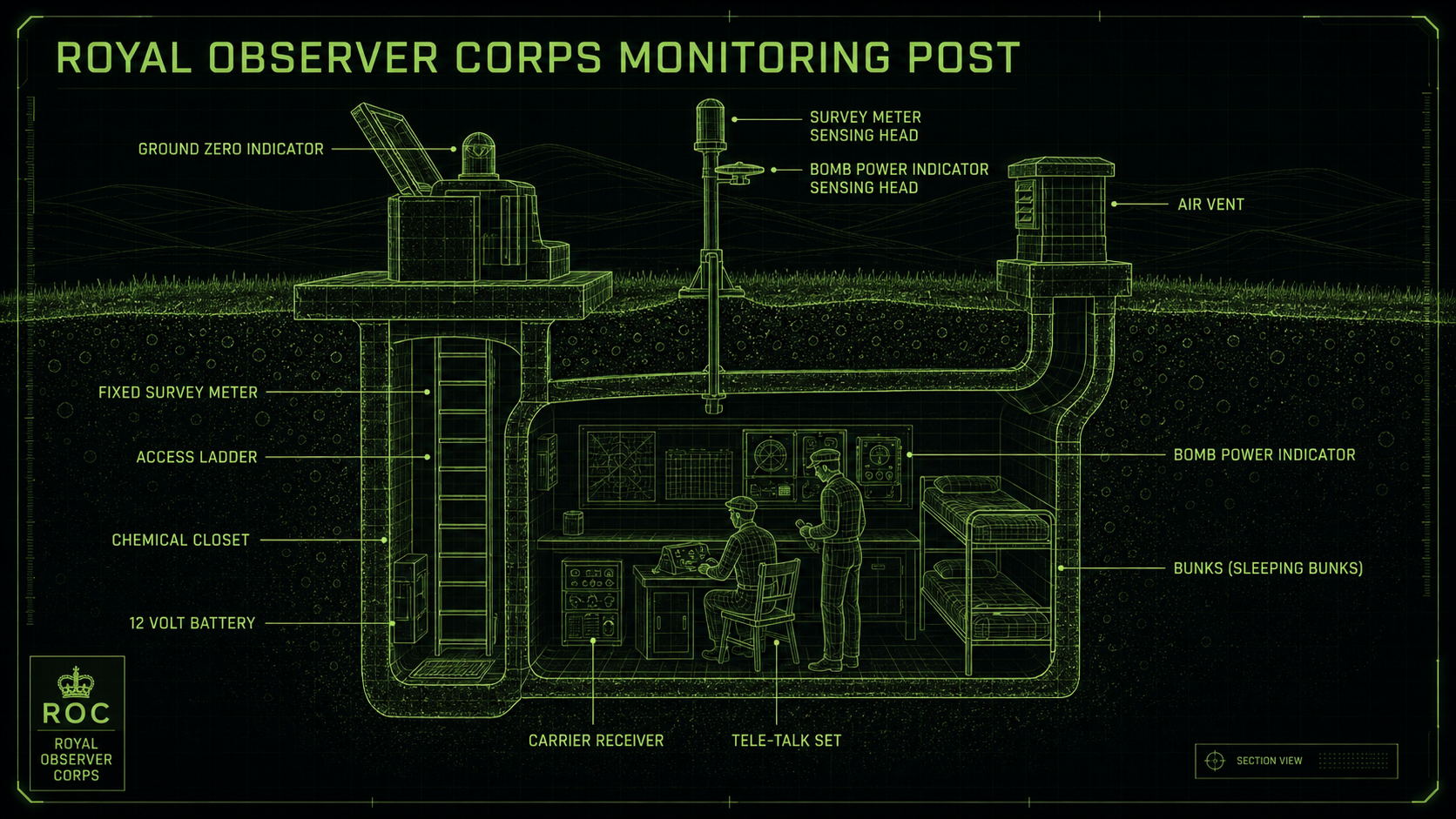
Inside a monitoring post

Green technical cross-section diagram of a Royal Observer Corps monitoring post.
  • Access shaftAbout 14 feet down to the underground rooms.
  • Monitoring roomWorking space for instrument readings and reports.
  • VentilationSurface vents kept the post usable while remaining low profile.
  • Store areaA small toilet and store supported longer watches.

Reporting chain

  1. PostObservers recorded burst direction, pressure, and radiation readings.
  2. Group ControlReports from multiple posts were plotted and checked for consistency.
  3. Sector ControlScientific teams built the wider fallout and warning picture.
  4. UKWMONational warning channels turned confirmed data into public and government alerts.

Instrument glossary

BPI

Bomb Power Indicator: a pressure gauge used to estimate blast overpressure.

FSM

Fixed Survey Meter: a radiation instrument used to monitor dose rate from inside the post.

GZI

Ground Zero Indicator: a flash-bearing instrument used to estimate burst direction and elevation.

Group Control

The protected headquarters that received post reports, plotted data, and coordinated onward reporting.

Network hierarchy

The ROC operated across four tiers. Each tier served a distinct role in turning raw instrument readings into a national warning picture.

  1. UKWMO Sector Five wide areas (Metropolitan, Southern, Midland, Western, Eastern) plus Northern Ireland. Each Sector Control held a scientific team that synthesised Group data into regional fallout predictions.
  2. Group Each Sector contained several Groups, each with a protected Group Control bunker. The Group Control plotted incoming post bearings on a large map board and passed consolidated reports upward. Great Britain had 29 Groups at peak strength.
  3. Cluster Within each Group, posts were gathered into radio clusters — typically three to five posts sharing a single cluster master. The master post was equipped with VHF radio as a backup to the telephone landline, so reports could still reach Group Control if landlines failed. The cluster boundary is shown as a green polygon on the map.
  4. Post The underground monitoring post: a 14-foot-deep concrete bunker staffed by two or three volunteer Observers. Each post held a GZI (flash direction), BPI (blast pressure), and FSM (radiation dose rate). Posts called in readings on a fixed schedule.

Group 20 (York) used this four-tier system. The map on this page shows the Eastern Sector → Group 20 → its thirteen clusters → all ~40 posts as they were on the March 1989 ringbell.co.uk operational map.

Open training extract

Training extract

Report discipline

A useful post report was short, repeatable, and easy for Group Control to plot. Readings were checked against the instrument, spoken clearly, and logged before the next watch update.

  • Confirm the post number before passing a reading.
  • Keep burst, pressure, and radiation observations separate.
  • Send corrections quickly when an instrument value changes.

Group Control Operator

Plot the supplied post reports

Enter three numbered post reports and their true bearings. The workstation resolves the pairwise intersections and returns a coordinate fix for onward identification.

Bearing conversion reference

TRUE = MAGNETIC FIELD READING + WEST VARIATION + CARD ERROR

If result ≥ 360.0°, subtract 360.0°.

Awaiting three post reports.

Group 20 — York

The complete cluster structure

Group 20 covered the North and East Ridings of Yorkshire and the West Riding after the 1968 reorganisation, reporting to York Group Control at the Acomb bunker (opened 1961, now preserved by English Heritage as York Cold War Bunker). At peak the Group ran approximately forty underground posts organised into thirteen radio clusters. The table below follows the March 1989 ringbell.co.uk map.

Group 20 cluster structure — March 1989 (source: ringbell.co.uk)
Cluster Master post Post No. Satellite posts
Northallerton Northallerton 10 Bedale (11)
Bedale area Middlesmoor 33 North Stainley (30), Kirby Hill (31), Darley (32)
Pickering Pickering 17 Kirby Moorside (16), Wykeham (23)
Bridlington Bridlington 20 Skipsea (21), Langtoft (22)
Buckden Buckden 25 Grassington (26), Settle (27), Horton-in-Ribblesdale (28)
Strensall Strensall 38 Brandsby (37), Birdsall (15)
Pocklington Pocklington 35 Tockwith (36), Fulford (47)
Guiseley Guiseley 40 Thornton (41), Keighley (42), Gargrave (43)
Barwick Barwick-in-Elmet 65 Camblesforth (45)
Beverley Beverley 51 Holme-on-Spalding-Moor (50), Gilberdyke (52)
Tunstall Tunstall 55 Keyingham (56), Skirlaugh (57)
Heckmondwike Heckmondwike 62 Sowerby Bridge (61), Thornton (41)
Holmfirth Holmfirth 60 Darton (67)

Master posts (red on the map) held VHF radio sets as a backup communication path to Group Control when telephone landlines were unavailable. Tunstall (post 20/M2) was the master from 1975 to stand-down in 1991. The cluster boundary lines shown on the map correspond to the green sector markings on the original ringbell.co.uk operational map.

Volunteer roles

People behind the plots

  1. Post Observer Maintained watch, read instruments, and passed concise reports to Group Control.
  2. Chief Observer Led the post crew, checked readings, and kept reports consistent during exercises.
  3. Scientific Team Interpreted burst, pressure, weather, and radiation data for warning decisions.

Further reading

This page uses town-level plotting for Group Controls and the full Group 20 cluster topology from the March 1989 ringbell.co.uk operational map. Sources are grouped by topic and avoid access guidance for private or unsafe sites.